Saturday, 6 February 2016

Talking Turbines - The Lotus 56B

Emerson Fittipaldi at Monza 1971

'Pratt and Whitney', two names synonomous with the world of aviation for producing engines. Yet in 1971 the cutting edge Lotus team married a such an engine to a Formula 1 car. The result was the gas turbined Lotus  56B, a radical approach to speed whose journey and development proved bitter sweet.

The 1949/50 'Rover Jet 1
If your unsure what a gas turbine is your probably not alone. Quite simply its an engine which uses the rush of high speed hot burning 'gas' to spin a turbine. The jet engine on a commercial airliner is a form of gas turbine. However rather than propelling itself with fast exiting gas known as 'thrust', a spinning turbine can rotate a shaft for drive. In this form your will find these packing a punch in helicopters and turbo prop aircraft. Some saw the potential of these relatively compact, lightweight and powerful engines to power a road car.

Rover had been experimenting with gas turbined cars, producing 'JET1' in 1949. After further development and prototypes they paired up with BRM to enter the Le Mans 24 hours in '63 and '65. A best place of 8th showed some promise and potential.

1965 Rover-BRM Le Mans entry

Across the pond American Ken Wallis approached motoring legend Carol Shelby, attempting to drum up interest and backing for a gas turbine racer. His idea was laughed off but he had better luck with Andy Granatelli of the STP oil corporation. With financial backing a car was to be produced for the great Indianapolis 500. The STP-Paxton Turbocar known as 'Silent Sam' would debut the gas turbine at Indianapolis. The metallic rumble of a piston engine was replaced with a jet like 'woosh'. Unusually the Pratt and Whitney ST6 engine was mounted side by side with the driver. It also featured four wheel drive, simplified by the fact the car didn't need a clutch or gearbox. At its debut at at the 1967 Indianapolis 500 the car took a commanding lead. With just eight laps remaining the car retired with a transmission bearing failure. Although not scoring points the car had demonstrated unmatched pace with its relatively compact and powerful power plant. The governing body feared dominance and wanted to reduce the performance advantages. For the following year air restrictor plates were to be fitted to gas tubine entries.

Like Father Like Son: Damon Hill driving his Dad's 59
The 'Silent Sam' with its side by side engine layout

The potential was recognised by Colin Chapman's legendary Team Lotus, a team always pushing the boundaries of engineering technology. Impressed with the British outfit's proven track record the STP oil corporation duly supplied sponsorship money. Andy Granatelli worked alongside Colin Chapman and Lotus designer Maurice Philippe to produce a contender. The same Pratt and Whitney ST6 engines were supplied with some small modifications. With Team Lotus' creative chassis design and resources the result was a much more sophisticated effort than 'Silent Sam'. It featured a low slung nose to give the car an aerodynamic 'wedge' shape. Coupled with the Lotus ethos of keeping overall weight to an absolute minimum the design clawed back the lost ground from the air restrictor plate.

Graham Hill at the 'Brick Yard', aka Indianapolis

Entering the 1968 Indianapolis 500 with four cars the project was to star the phenomenal talent of Jim Clark. The double Formula 1 World Champion had already won the famous race in 1965 and was teamed with the equally successful Graham Hill. Sadly Clark was killed in a Formula 2 race at Hockenheim that year and was replaced by Mike Spence. The tragedy was to be further compounded before the race began. The car proved competitive in practice when Spence set the fastest average speed of 169.55 mph. However when misjudging the entry to the first corner his car smashed into the unforgiving concrete wall. The right front wheel entered the cockpit and left the 31 year old with fatal head injuries. The three remaining cars of Graham Hill, Joe Leonard and Art Pollard entered the race. Pollard was the last team car remaining and with a few laps to go narrowly missed out on victory, retiring from the lead with fuel pump failure. The 'Silent Sam' STP-Paxton entry had missed the grid after a previous crash in qualifying. It seemed only a matter of time before a gas turbine powered car was going to take victory at Indy. Unfortunately a new raft of rules from the governing body would make this form of propulsion uncompetitive.

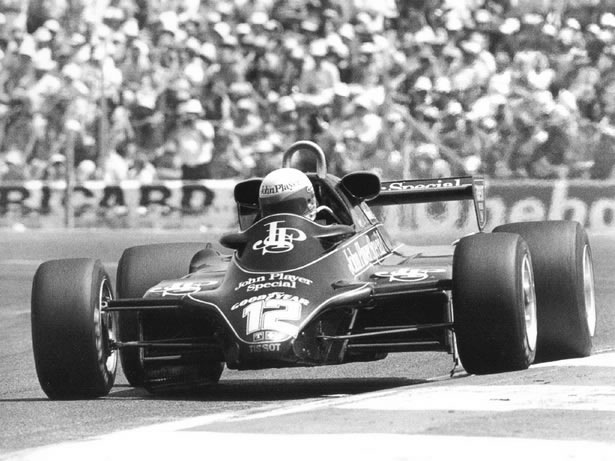
Fittipaldi in the 56B
Colin Chapman had intended the 56 to also compete in Formula One, and Lotus developed the modified 56B. The gas turbine produced approximately 600hp, which was around 175 hp more than its piston engined rivals. Once the turbine reached optimal rotation the acceleration was unmatched. Furthermore no gearbox was required or a bulky cooling system. The engine had less moving parts which made it potentially more reliable. Four wheel drive grip made the car superior in wet weather. However there were significant disadvantages. Primarily the gas turbine was very thirsty, with the stop start nature of a Grand Prix racing requiring extra fuel capacity. Heavy tanks stored 280 litres in the sidepods. The gas turbine engine also suffered from hugely unresponsive lag. Forget your primitive turbo cars of the 80's, here waiting three seconds for the power after hitting the throttle was quite normal. Engine braking was non existent and the throttle was also unresponsive when backing off, pushing the car further into the corner. A hefty inboard braking system was required to handle the extra requirements. Suddenly what seemed minor hurdles at Indianapolis were becoming big obstacles to the 1971 Formula One campaign.

The car debuted at the non-championship Race of Champions at Brands Hatch that March. Emerson Fittipaldi qualified 7th but retired with suspension failure. The same problem plagued the car at the next two non-championship meetings, but Fittipaldi managed 3rd place in the final heat. What was becoming apparent was the four wheel drive made the 56B untouchable in wet conditions. However in the dry this system would have produced undesirable understeer making driving this strange car even more of a challenge. According to Fittipaldi it was "very difficult to drive. Very very difficult. We knew we would have to do a lot of development on that car to make it competitive, but it never gave good results."

The Pratt and Whitney ST6 in the back of the 56B, Monza
Dave Walker almost look set to take victory at the Dutch Grand Prix at Zandvoort. Utilising the superior grip of 4 wheel drive in the wet, he carved his way through the field only to spin out. Another retirement followed at the hands of Reine Wisell at the British Grand Prix, this time with mechanical issues. The Lotus 56B's final championship outing at Monza with Emerson Fittipaldi scored a mediocre 8th. At the front Peter Gethin, Ronnie Peterson and François Cevert enjoyed the closest finish in Formula 1 history. A lap down Fittipaldi tried desperately to hussle the over weight and understeering 56B towards a good result but the hot weather hindered the performance of the gas turbine engine. The season ended with no wins even though the conventionally powered Lotus 72 was still being used that season. With resources being poured into the gas turbine car the team feared its proven Lotus 72 was becoming neglected. Coupled with Emerson Fittipaldi's lack if patience with the project, the 56B was shelved at the end of the year. The car was entered that year for one last race, an F5000 event at Hockenheim where Fittipaldi placed an impressive 2nd. The following year the Lotus 72 would go on to win the Formula 1 World Championship. The gas turbine wouldn't be pursued in Formula 1 again. This was overshadowed by a certain paranoia that any expensive development road would be pointless if the technology was outlawed. The sole Lotus 56B in existence has been restored and remains under the ownership of Team Lotus [below].

                   "I think this was a blind alley because if we had eventually become successful with it, it would promptly have been banned and then a great deal of money would have been wasted. It happened before at Indy, where the four-wheel drive turbine cars were banned as soon as they started to be successful. Unfortunately the innovator in motor racing is often penalised the moment he produces something of benefit to himself and which makes his cars go faster than those of other competitors. If I could have been sure of at least two year's stability, I would have carried on with developing it, because the turbine is a very good converter of torque. What was wrong with it in Grand is that we ran it with four-wheel drive. If we had built a two-wheel-drive turbine I think that with its smoothness, its very high torque at low rpm and the power it was capable of producing under the formula equivalence, it woukd have been very competitive." -Colin Chapman, Team Lotus

The sole remaining Lotus 56B at Autosport International 2016


Sunday, 19 July 2015

Back to the Future – How Ground Effect could save modern F1

Sometimes the answers can come from the past..


What should an F1 car be? Ask most fans and they would tell you the fastest circuit race cars on the planet. They should have a degree of difficulty to drive that allows talent to shine through. They must have a purity in design and driving experience that reflects the pinnacle of motorsport. The racing spectacle should be as entertaining as possible whilst the sport being at the forefront of technology to keep the manufacturers involved.  This balancing act and ideal vision of the sport has become somewhat eroded. Yet look into the sports past and you will find a technology that could re address this balance and bring the spark back the audiences are currently longing.

Still tail happy at low speed
What are the modern turbo F1 cars like to drive? Certainly they are not the turbo charged monsters we saw in the 1980s era. Many including me fantasised of ridiculously powerful cars squirming sideways and forcing the drivers to wrestle them into submission. Even with recent rules restricting downforce, modern cars have so much more grip than their 1980s counterparts. They feel glued to the road and more refined compared to rocket propelled shopping trolleys. At slow speed the back end will still squirm under the huge torque of the turbo engine breaking traction. But throw the car into a bend at speed and the front wing and complex rear diffuser will produce a huge amount of downforce making the car feel stable and planted.  That’s right, modern F1 although recently dominated by engines is still all about downforce.   Back in the 1980s teams were dominated by engineers, today the design teams are guided by aerodynamicists. HNDs have made way for Aeronautical degrees as reluctant poster boy Adrian Newey proved with success that every aspect of the car should be optimised for aero efficiency.  Now aerodynamicists lead the design direction of the car.

Complex modern front wings
There is one single component on an F1 car that generates around a third of this downforce. It is the front wing. By means of hugely complex winglets and end plates these wings also play a vital role in channelling air around the disruptive tyres and under the car. As rule changes evolved this component has become the holy grail of car design. You might find your F1 nerd trying to impress by attempting to explain the latest wing upgrade that he has read in Scarb's blog or Autosport magazine. The truth is such is the complexity you truly need an Aeronautical degree to really understand the design direction of front wings. Teams plough millions into developing them which individually cost alone around £100,000. Think of this when Maldonado love taps his next opponent and comes into the pits for a new one.
'Dirty Air' phenomenon
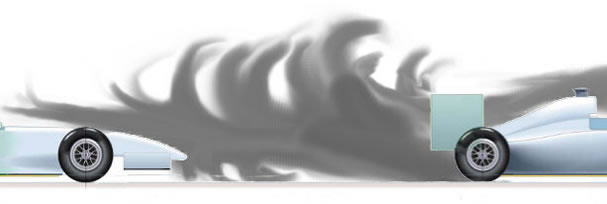
The serious problem with this hugely complex piece of carbon fibre is overtaking. When chasing another driver you may hear a radio transmission complaint about ‘dirty air’ or losing time tucked up behind an opponent. Once a following car gets close behind a car in front it enjoys the advantage of a hole in the air being punched open. This is great down the straights as the hole generated by the opponent allows it to ‘slipstream’ behind and gain an advantage from less drag. However, approach a corner under braking and enter a bend and this lack of air doesn’t allow the front wing to work. The air flow it does receive has already been shaped and manipulated by the car in front so doesn’t flow as it should. This ‘dirty air’ reduces front end grip and produces understeer, meaning the car doesn’t want to turn into the corner. Continue to try and close the gap and overtake and this understeer produces unnecessary front tyre wear and can rapidly snowball during a race when tyre wear is all important. Cue drivers backing off and saving their tyres and accepting the position they are in. This is caustic to racing and a sad reality of modern F1. The slow reacting FIA are aware of this and have tried to band aid the racing with DRS zones to artificially boost the chasing driver. In 2009 ‘tea tray’ style wide front wings were bought in to channel air around the outside of the front tyres thus attempting to make the front wings less sensitive to dirty air. Although we saw plenty of overtaking in the following years this was down to new high-degradation Pirelli tyre compounds and the introduction of DRS. The front wings were still very sensitive to dirty air and increasing their size had only increased cornering speed. They were soon shortened in 2014.

Ground effect 'Venturi' tunnels
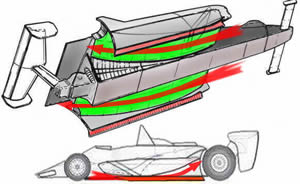
If you asked an alien to design a fast single seater racer using earth’s technology, would it have a large and highly important, expensive and complex front wing? No and far from it. To find the most natural, simple way of a car producing high amounts of downforce with as little cost and drag as possible you have to go back in time to 1977. Legendary Lotus founder Colin Chapman had been studying aerodynamics at the British jet fighter manufacturer De Havilland. Aerodynamics had already come to importance over 10 years ago when ‘wings’ appeared on racing cars. Wings are in fact upside down aircraft wings. Instead of producing lift the wing produces downforce, pushing the car into the ground and producing grip and speed. Colin was further inspired by fluid dynamics and how they worked on De Havilland’s ‘Mosquito’ fighter aircraft. He came to realise that the underside of the car could be profiled into a curve, similar to a wing face. Plastic brushes and later rubber around the edge of the cars floor created ‘skirts’ which stopped air interfering with this large area of low pressure. The ‘Venturi’ affect as it is called would basically turn the entire car into a wing, sucking it to the ground. His ideas were relayed back to his designers Peter Wright, Martin Ogilve, Tony Rudd and Ralph Bellamy. Penned as the ‘Lotus 78’, a new car was born out of these ideas and principles. The front wing was small and skinny and all that was required to address balance and allow the underside of the car to work optimally.  Sculptured after many hours in Imperial College London’s wind tunnel, the result was in my eyes the most beautiful car to ever grace a racing circuit. 
    
The Lotus 79 changed motorsport forever
Introduced for the Argentinian Grand Prix in 1977 the benefits were obvious and the cornering speeds were phenomenal. Unfortunately the grip was being generated so far forward in the car that a huge rear wing was required to keep the back end in check. This meant the car suffered on the straights with drag. This coupled with an underpowered and over worked Cosworth DFV it wasn’t enough to top the season and the team finished the constructors championship 2nd. Efforts went into reducing the rear wing size and tendency to oversteer for the new much more rounded '79'. That went on to win 9 of the 15 races and won the World Championship with Mario Andretti.  A successful year was marred by the death of the talented team mate Ronnie Peterson, succumbing to injuries sustained from an off-line pile up at the Italian Grand Prix. It would prove to be Team Lotus’ last World Championship and it wasn’t long until the rest of the field cottoned onto the advantages of ground effect. However many teams did not have the budget for wind tunnel testing and the results were crude applications often with undesirable side effects. Disturbances in the airflow under the car would cause cars to ‘porpoise’ or rock back and forth. This could often be violent and was particularly uncomfortable for the driver as the cars had to be run on rock hard suspension to maximise efficiency. At times the cars could lose their ground effect and grip in an instant with scary results.

 ‘To be honest, there was no such thing as cornering technique in the ground effect era.  “Cornering” was a euphemism for rape practised on the driver. . . When you came into a corner you had to hit the accelerator as hard as you possibly could, build up speed as quickly as possible and, when things became unstuck, bite the bullet and give it even more. In a ground effect car, reaching the limit was synonymous with spinning out.’ – Niki Lauda
1982 proved a dangerous season
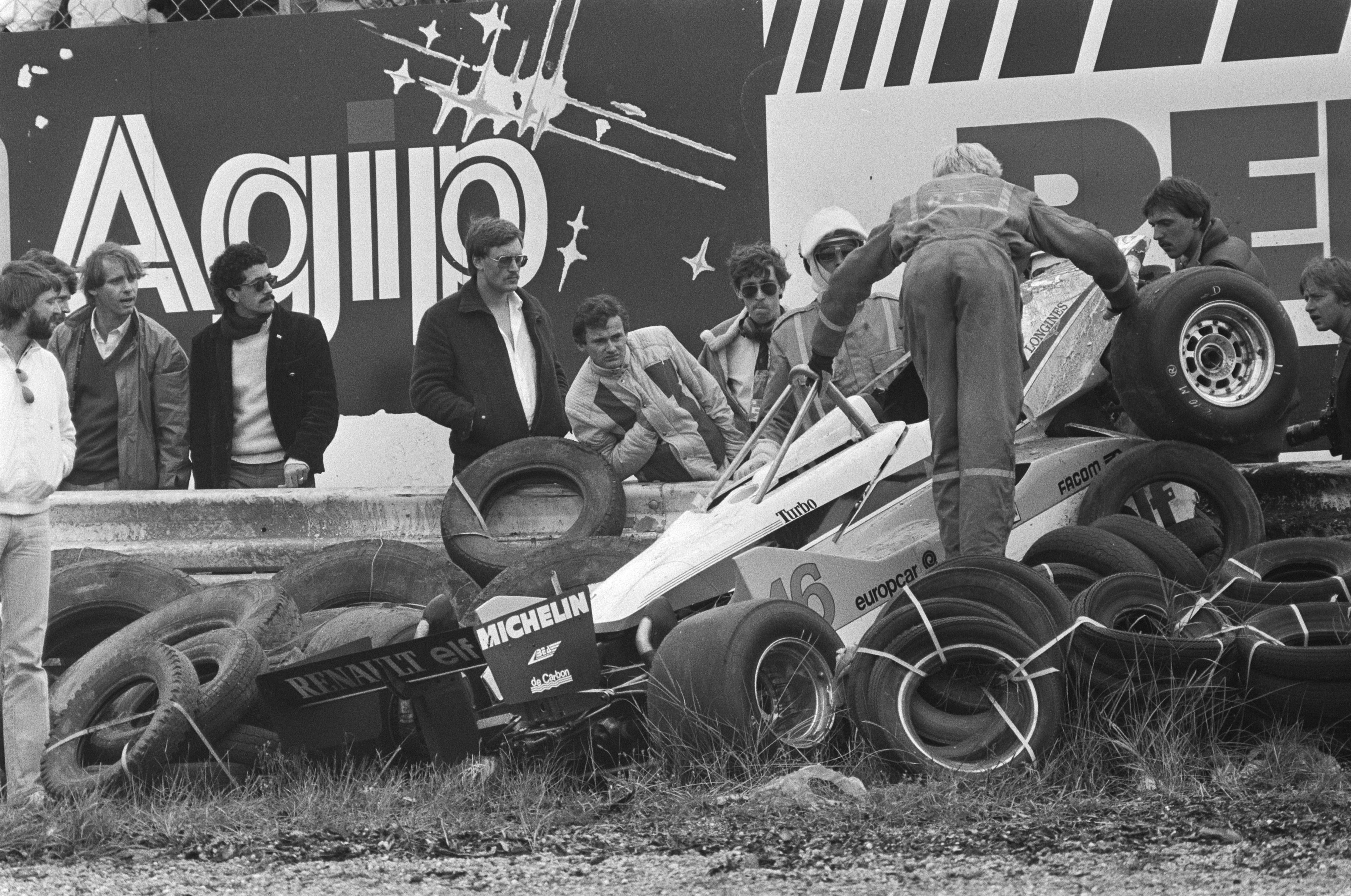
FISA were worried with cornering speeds and teams experimenting with ground effect with very little aerodynamic knowledge. Skirts could break sending cars off the track at high speeds. Patrick Depailler was killed testing for the German Grand Prix in 1980. While the accident was blamed on suspension failure and poor guard rails the car was travelling at significant velocity at the high speed Ostkurve, thanks to ground effect. The following year skirts were banned by FISA but teams had other ideas such was the advantage. Skirts that dropped out on circuit but retracted to hide from scrutineering were developed and FISA lifted the ban in 1982. Cars continued to have accidents at very high speeds with legend Gilles Villeneuve losing his life at Zolder in Belgium. Although not the cause of Villeneuve’s death, again the high speed of the cars played a factor. Turbo engines were beginning to appear in F1 and were looking to make a scary combination. Villeneuve’s team mate Didier Pironi suffered a horrific crash at the German Grand Prix were the ground effect of the cars in front had thrown up a fog like mist from the wet race track. Unsighted Pironi smashed into the back of Alain Prost’s Renault severely injuring his legs, surviving but ending his career. Across the pond Gordon Smiley lost his life in an horrific high speed accident in his ground effect car at the Indy 500. FISA had enough and made a flat under tray under cars which effectively banned ground effect from Formula One. While it continued 

Today in principle we still have ground effect but at a very restricted level, with the diffuser at the rear of the car. Bring back unrestricted ground effect with today’s understanding of aerodymanics would result in the drivers having to wear G suits – the cornering speeds would be ridiculous and highly dangerous. However remove the complex over body aerodynamics and the over reliance on the front wing and you have the potential for some great racing. Limitations, be it on tyre compound and some clever restrictions on the ground affect area would bring the cornering speeds down to acceptable levels. This wouldn’t be the highly explosive twitchy cars of old. Ground effect can now be applied with modern safety standards. The band aid of DRS would be redundant and even road cars would benefit from the most efficient way of producing grip in this age of efficiency.

Now it looks like the F1 circus is starting to see sense, with proposals for ground affect for 2017 up for discussion by the Strategy Group.  Jenson Button supports the notion, “if you’re going to work with downforce it should come from the floor rather than the wings, because you can race closer and fight, and you don’t have as much dirty air from the wings for the car following,”   


Let’s hope the proposal makes some serious inroads. In 2012 the idea of ground affect was thrown out the window with teams stating their worry over costs. The reality was the dominant and powerful teams in the sport at the time, namely Redbull and Ferrari, didn’t want the pecking order shaken up by a fundamental redesign. You can be ensured after this initial investment the costs of development would be slashed ­­­­. Bring it back I say…

Elio De Angelis at the French Grand Prix 1982

R.I.P Jules Bianchi


R.I.P Jules Bianchi 1989-2015. Such as tragic end to a young life and talent.

Sunday, 14 June 2015

Motorsport Justice at Le Mans - Hulkenberg, Tandy and Bamber bring Porsche victory


The #19 and #18 Porsche cross the line

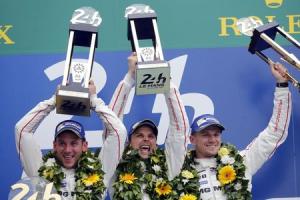
The motorsport Gods cast light at Le Mans this weekend. A trio of drivers who hadn't been gifted with the opportunities or money of their compatriots shared the seat of the winning Porsche 919, bringing the manufacturer its first top class win in 17 years. Nico Hulkenberg, who many believe has never had a car in F1 capable of delivering the results his skills deserve, took the chequered flag to a sell out crowd at le circuit de la Sarthe . But if it wasn't for the stellar performance of British driver Nick Tandy and kiwi Earl Bamber this record wouldn't have been possible.

Porsche's first win in 17 years
The win granted Nick Tandy the honour of the first British winner at Le Mans since 2003. Nick began his climb to the top of motorsport by following his older brother's Joe route into the unconventional working-class world of Mini Stox racing. Both himself and Joe enjoyed success winning National and regional races and titles. Progressing onto Formula Ford Nick's talent was further recognised, but more often than not a lack of money bought performance handicaps. To his aid his brother Joe with a fresh engineering degree formed 'Joe Tandy Racing' and produced competitive cars for his brother in Formula Ford and F3. Unfortunately the good times were about to come crashing down when Joe driving a BMW 5 series collided with a van at a junction in Bedfordshire. It proved fatal for both himself and his to-be brother in law in the passenger seat. Nick vowed to continue on and 18 days after the incident scored the team's first win in F3 with a dominant performance at Rockingham. An opportunity to race in the German Porsche Carrera Cup lured him to sports cars, scoring 2nd place in his first race with no testing experience. Success followed and in 2013 he was signed to the Porsche factory team. His performances and loyalty to the Porsche family won him his drive this year in the third Porsche 919 Le Mans racer.

Nick Tandy began his racing in MiniStox
Of course many of you will be aware of the predicament of F1 racer Nico Hulkenberg. Highly rated by many in the sport, Nico lost his opportunity for a top team contract to Kimi Raikonnen for the 2014 season. His lap times in comparison to team mates speak for themselves, but Ferrari favoured their previous World Champion Kimi. For me and many that was not a wise decision. On his good days the popular bad boy of F1 Kimi has amazing talent, but since getting battered by his team mate Massa in 2008 has become a bit of a spent force. To Ferrari however a driver consistently able to challenge their lead man Vettel wouldn't be welcome.

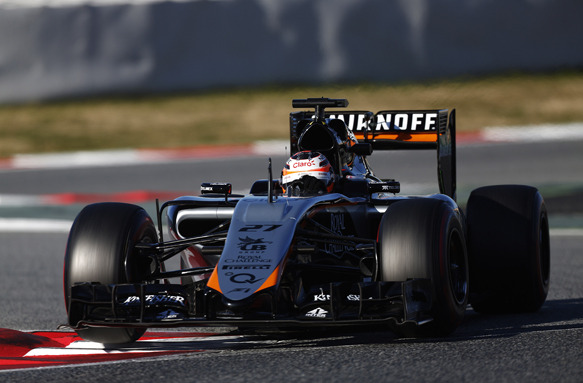
Nico continues to campaign on in F1 driving the inferior machinery that is the Force India. Although this huge Le Mans win will further raise his stock value in the sport, could it entice him to race in sports cars full time? With Formula One being slagged off left right and center on social media with Mercedes domination, quiet engines and boring races of recent a factory drive with Porsche seems tempting.
Will 'Hulk' be tempted out of F1?
An exciting Le Mans this year has only raised the World Endurance Championship's profile and that unbeatable winning feeling might have stirred something inside Hulkenberg. No one wants to spend their years racing mid field machinery in F1 so could this be a tipping point?

And lets not forget the third driver of the winning car, New Zealand's young Earl Bamber. Coming through the ranks of the expensive world of single seater racing on a tight budget, the kiwi took the same decision as Tandy to move to the comparatively cheaper world of sports car racing. Winning the Porsche Carrera Cup Asia in his first season in 2013 proved his credentials and another year of Porsche racing followed. Signed up as a works factory driver for Porsche this year at the age of 24, he was gifted given the opportunity to race at Le Mans this year with Hulkenberg and Tandy in the #19 Porche 919. His good friend and fellow New Zealander Brendon Hartley drove the lead Porsche 919 #17 car this year with Mark Webber and Timo Bernhard.

Sun rises at Le Mans
At what of Mark Webber, the man favoured to lead Porsche to victory this weekend at Le Mans? During the evening young kiwi Brendon Hartley made the a mistake of not slowing down enough under double yellows in the new 'slow zone' and so the #17 Porsche was penalised with a one minute penalty. This was left for Webber to serve after jumping into the seat shortly after. This took the car out of the race and some very quick laps by Nick Tandy in the #19 Porsche bought his car into contention. The chasing #7 Audi lost its bodywork requiring pit repairs and the only other threat from the team's #9 car ended when a front driveshaft required changing. Earlier in the race Loic Duval's #8 Audi had also suffered bodywork damage when clashing with battling GT cars on the circuit, costing 2 minutes and bringing it out of the battle at the front. This would be the first time the German marque had lost Le Mans since 2009, after a dominating run of 12 wins in the last 15 races.

The polesitter and third Porsche dropped down the order when Neil Jani and Romain Dumas both had a copycat lock ups bringing them off the track at the end of the long Mulsanne straight. Last year's World Endurance Champions Toyota continued to struggle with a lack of pace and were not in the same league as the Porsche and Audi cars all weekend. The best placing Toyota was the #2 of Alex Wurz, Mike Conway and Stephan Sarrazin who were able to salvage a 6th place out of Audi's issues.

Nissan struggled with its radical concept
Nissan's radical GT-R Nismo's race was already played down as a test session rather than a challenge for glory this weekend, with the cars regularly visiting the garage to keep them going. The front wheel drive car struggled with traction out of the corners and a scary moment ensued for Exeter boy Harry Tincknell - loosing his front bodywork and lights in the darkness of night. It was the only car to cross the chequered flag, be it unclassified for being too far back.

In other classes the KCMG Oreca of Nicolas Lapierre, Richard Bradley and Matt Howson led a convincing victory in LMP2 after stopping on track at one point with reliability issues. The GT class was won by the loud roaring Chevrolet Corvette of Oliver Gavin, Tommy Milner and Jordan Taylor. Towards the end the Ferrari 458 Italia of Gianmaria Bruni took the lead only to drop to third after a heroic gearbox repair, with Italian mechanics pulling out and replacing individual gears in 45 minutes.

A historic Le Mans 24 Hours certainly bought a refreshing taste to motorsport after a few less than exciting Grand Prix races in recent months.

Sunday, 21 December 2014

Isuzu and Subaru in F1

During my career I have been lucky enough to be trained by Subaru and Isuzu UK. I have always had a keen interest of any involvement these manufacturers had in Formula One. In fact in the very early 90's both produced engines at the highest level of motorsport.

Isuzu

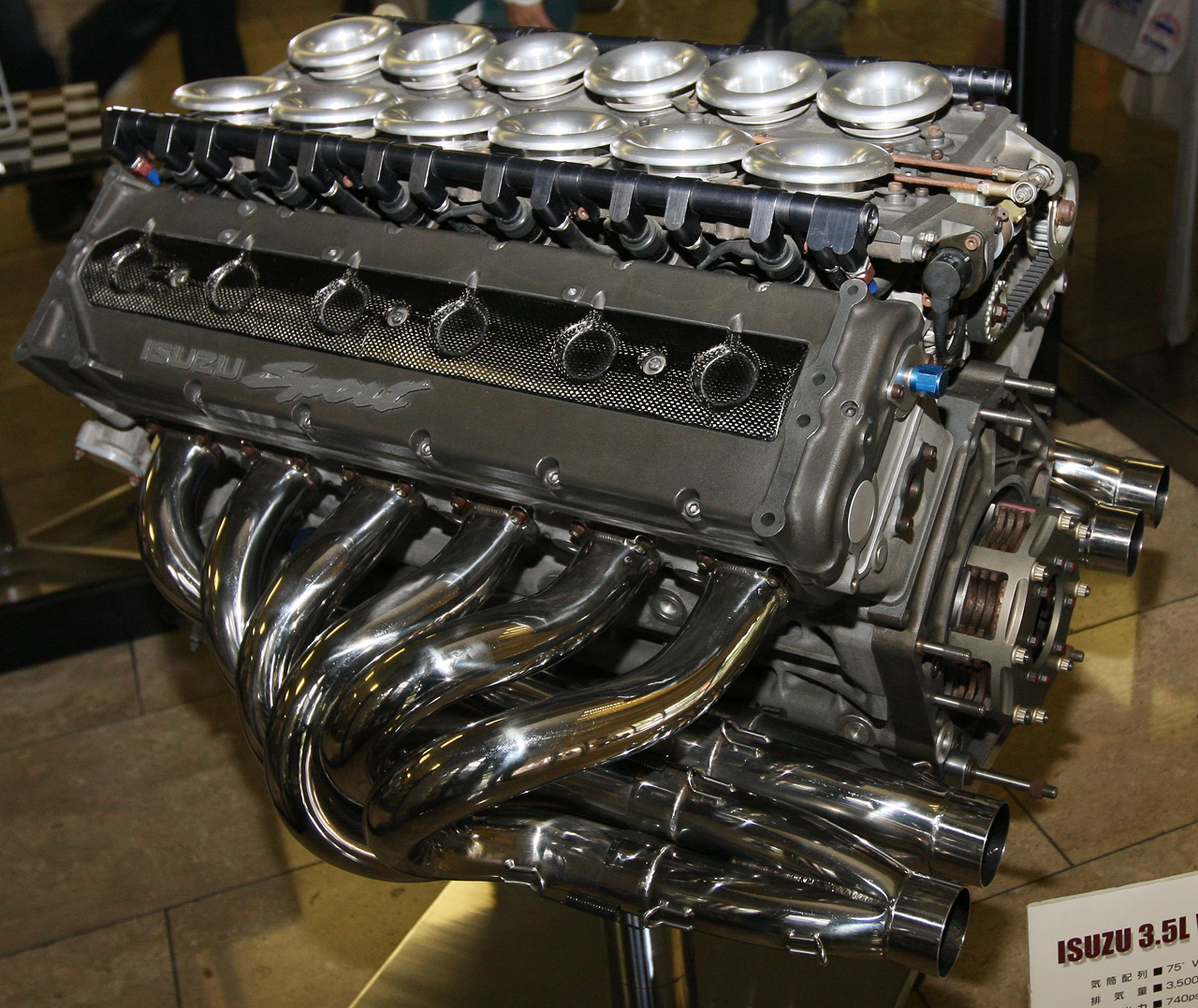
The last remaining P799WE on display at Tamiya, Japan
Isuzu is a brand well known for its rugged diesel engines powering commercial vehicles and trucks across the globe. It certainly was not known for involvement in racing. However by chance the Japanese manufacturer had an interesting yet brief flirtation with the pinnacle of motor racing, Formula One.

American car giants General Motors have owned an ever changing stake in Isuzu since the 1970’s. This is reflected in road vehicles like the Isuzu Trooper which was also sold as the Vauxhall/Opel/Holden Monterey. Its chairman Bob Eaton was a fan of the renowned British sports car manufacturer Lotus who were in spot of financial bother. After the death of their legendary founder Colin Chapman, Lotus struggled to keep afloat and General Motors purchased shares that would end in a majority stake by the end of the 80s. This led to Lotus helping with the development of the Isuzu Piazza and Gemini road cars and the acclaimed Lotus Elan, relaunched in 1989, featuring a solid Isuzu engine and gearbox. Even stranger was the ‘Lotus’ version of the Trooper/Bighorn SUV.

The 2nd Lotus Elan featured an Isuzu power train
On the racetrack, Team Lotus continued to campaign in the Formula One World Championship. In 1991 the team had an impressive line-up of Johnny Herbert and future World Champion Mika Hakinnen. Unfortunately the team’s car was uncompetitive and they searched for an engine partnership to raise their performance levels and finances. When the team failed to attract Honda they looked inwards and Isuzu expressed interest in producing an engine. They already had produced a V8 for a supercar concept, and a small team of only four people worked in secret to design a 3.5 litre engine to meet the then current F1 regulations.


Designated the ‘P799WE’ the stunning V12 engine produced 637hp on its first bench test. After some fettling this figure rose to an impressive 755hp. Isuzu sent an engine to Silvertone to have its first test in the back of an F1 car. On August the 2nd that year at Silverstone the it was mated into the back of
the Lotus 102 for 150 kilometres of testing. It was not a straight install however as the car was originally designed for an unreliable and heavy Lamborghini engine. In preparation the team bought a new engine cowling and larger radiators. A modified bellhousing mated it to the gearbox. There were issues however fitting in the alternator, meaning the car had to turn off some electrical systems and could only run for a limited number of laps at a time. Lotus team manager Peter Collins commented that it was “my first experience that a racing engine started on the first try”.

There is no official record of the lap times at the test apart from this engineers account:

       "By the way, the Lotus 102C Isuzu’s best lap time was 1:30. The same day, Senna in the McLaren Honda ran a 1:24.7 second lap and Maurício Gugelmin in the Leyton House car ran a 1:25.4 second lap. You see, the Lotus time was not the best, but Maurício Gugelmin had the first heat tires and both McLaren and Leyton House were running F1 racing gasoline. Some of the time difference is accounted for by the difference in tires and fuel. But this was the first dress rehearsal for the Isuzu, which was also carrying 80 kilogrammes of extra weight in batteries, because the car did not have an alternator. The setting was not perfect”

Hakkinen hustling the Lotus 102
Team manager Peter Collins commented in the media that he believed “it could be possible to team up for an F1 racing effort”. It seems that Lotus were impressed by Isuzu’s attempt and would be very keen on talking them into an expensive foray into the sport as an engine supplier. Unfortunately the Isuzu board of directors were not so keen. Isuzu was in the process of abandoning its road car efforts and focusing on the diesel SUV, pickup and commercial sector. F1 was ultimately brand advertisement for a manufacturer which didn’t align with the new direction of the brand. McLaren were even approached to use a road-tuned version in their awesome 'F1' hypercar. Sensing the lack of tried and tested pedigree the engine was beaten to the mantle by BMW. The single remaining P799WE now sits on display at the Tamiya headquarters in Japan and one of the four secretive employees now works for an unnamed F1 team. It seems great potential had gone to waste.

Subaru

Back in 1989, before Colin McCrae and the Impreza, Subaru of Fuji Heavy Industries was a brand known for its popularity with farmers and certainly not motorsport. The organisation had began to campaign its Leone coupe in the World Rally Championship, but not completing a full season. With an outlook to raise the brand's motorport profile Subaru set its sights on the big-time of Formula One.

Carlo Chitti and the Subaru F12
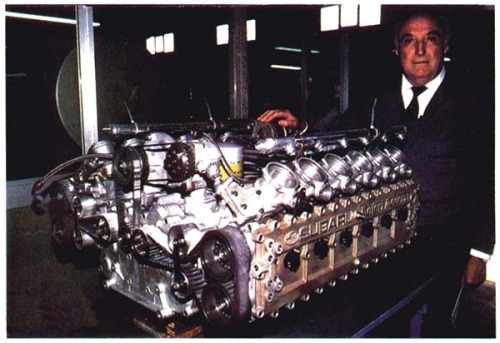
Rather than design in-house, it was decided to find an engine producer with experience in the sport to take the lead. The team looked to Carlo Chitti of Motori Moderni, Italy. Chitti was an aeronautical engineer who worked on the famous Shark Nose Ferrari F1 car of 1961 and also worked with Alfa Romeo in motorsport through the 70's and 80's. He had impressed with a V12 he was developing. Subaru requested an engine with its cylinders lying flat, similar in layout to its road cars. Former Japanese rally driver Yoshio Takaoka would oversee the project for Subaru.  It was thought that if they won races with a flat engine layout then new customers around the world would flock to the dealerships. With a low centre of gravity a flat engine is ideal in road cars but in the world of [then] modern F1 things were quiet different. A flat engine took up valuable lower space on the car that was used to produce downforce, reducing grip. It also provided a lot of difficult design challenges. Rather than use Subaru’s huge resources back home their decision to outsource a complicated design to a small outfit would come back to bite them.

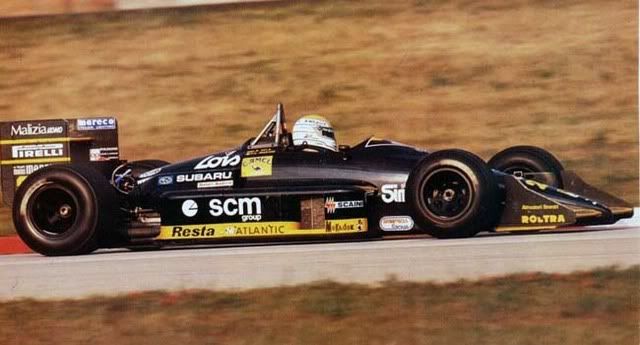
The Subaru powered Minardi M188 at Misano
Famous F1 minnows Minardi showed interest and arranged a test that year at Misano, Italy. The new 'F12' engine produced a good amount of torque on test day, pulling well at the bottom of the rev range. However after 6 laps a gudgeon pin failed and sent a conrod through the crankcase. Further testing continued, but after early promise of its capabilities it was apparent that the engine was overweight. Nissan had also arranged a takeover Fuji Heavy Industries putting doubts on Subaru's commitment to the project. Minardi walked away and looked elsewhere for engines.

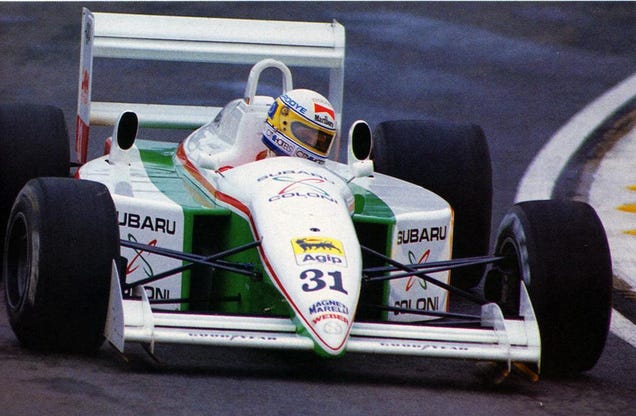
Betrand Gachot trying to get a hold on the ill mannered C3
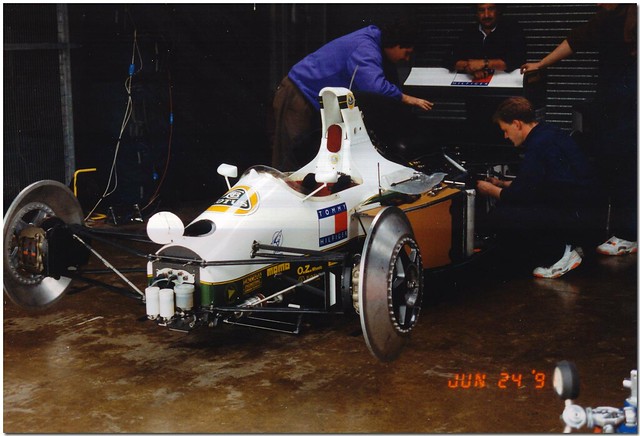
However the Nissan ownership had little affect to their ambition. A 51% stake in the struggling Scuderia Coloni F1 team of Italy was purchased. Former owner Enzo Coloni was employed as team manager and the team debts were paid off. For now the team would run a single car driven by Bertrand Gachot. With the new F12 engine that promised so much now only producing 500hp on the test bench, Subaru had come to the realisation that this engine was not competitive. Carlo Chitti was asked to begin designing a new conventional V12 engine to be ready for next season. For now a small amount of engineers at Coloni would try their best prepare a single car for races. Fitting the flat 12 into the back of their Coloni C3 was a challenge and the team had little time until the first race of the season at Phoenix, USA. Running out of time the car, engine and parts were flown over to America and the car assembled for the first time in the pit lane. The first official test however would not be on the track but in a nearby supermarket car park. The car was 140 kilogrammes overweight and sported bulky sidepods tailored around the Subaru F12. The car was in no state to post a competitive lap time and didn't get past pre-qualified. The whole weekend turned out to be an expensive car shake down.

The car continued to struggle through the next race weekends in Brazil, San Marino and Monaco but was unable to pre-qualify. Down on power the extra weight of the engine also made had made an already ill-handling car worse. By the 30th of May Subaru could not stomach any more and sacked Enzo Coloni as team boss. They also took full ownership of the team, purchasing 100% and putting its European division in charge. Unable to change the team name until next season due to regulations they continued on as Subaru Coloni, and planned to relocate in the UK. By this time Carlo Chitti had nearly finished designing the new V12 but Subaru explored other sources for next season's engine. Talk in paddock suggested the relationship was about to end. Reports suggested UK engine makers Judd were looking to supply Subaru next year. Bertrand Gachot put in a stellar performance at Mexico, beating rival EuroBrunn and Life cars in pre-qualifying. However there was still not enough pace to qualify for the race. At the following event at France the engine punched a hole in its casing, and two weeks later at Silverstone it spluttered around on only 8 of its 12 cylinders. Subaru could not endure any more and by July pulled the plug on its F1 project completely. The team was sold back to Enzo Coloni debt free but without engines or sponsors. Coloni sourced Ford engines and continued to campaign that season. They finished the year having not qualified for one race.

The whole project had been an expensive disaster that perhaps was doomed from the start. One can't help think what could have been achieved if Subaru had developed the engine completely in house on a bigger budget. Thankfully the brand had much more success in motorsport when it finally committed to a full season of the World Rally Championship in 1993, teaming up with Pro Drive. By 1995 they won the championship with Colin Mcrae, and 3 years later the popular Colin Mcrae Rally computer game for the Playstation sold out. The popularity of the Subaru brand skyrocketed and boy racers everywhere aspired to own an Impreza turbo. A legend was born...

The Impreza's rally sucess and appeal hit new heights 


Monday, 25 August 2014

Controversy at Spa - Tensions at Mercedes Reach Boiling Point as Rosberg and Hamilton Collide

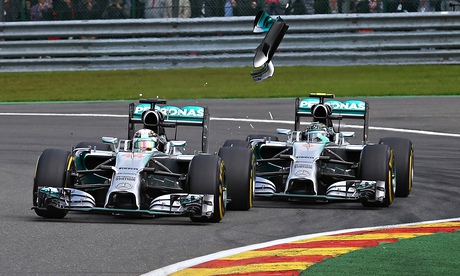
It seemed only a matter of time before the two Mercedes team mates Rosberg and Hamilton were to make controversial contact on the track. After a year of tensions building between the former karting friends and team mates, an incident indeed did occur this weekend that has seemingly sent Mercedes into disarray.

Rosberg's front wing end plate flies through the air after contact
On only lap 2 after a nail biting start, Rosberg was lining Hamilton up for a pass at the end of the long Kemmel Straight. Enjoying the advantage of a slipstream, Rosberg positioned his car for a move around the outside of Hamilton into the right-left of Les Coombes. Rosberg knew at the time that a pass at this stage was quite critical, or he risked Lewis steaming away into the distance.

As he positioned his car on the outside of Hamilton at the corner entry, he had enough space to get the front of his car alongside. However as Hamilton took the normal racing line into the corner, Rosberg fell back slightly. Within a matter of a seconds it was obvious that a move was off the cards. For whatever reason Rosberg chose not to come off the throttle. His right front wing end plate met the right rear tyre of Hamilton causing a puncture. As Hamilton limped his car to the pits, Rosberg also headed to the pits at speed to replace his damaged front wing and recover to 2nd place. Hamilton was less fortunate, his tyre had delaminated and continuously battered the floor of the car, robbing him of downforce. After spending the majority of the race at the back of the field with no performance to chase for points, he decided to retire before the end of the race and save his engine.

An incensed Mercedes team could not believe its drivers would collide so early in the race and the team be robbed of a potential one-two, Niki Lauda and Toto Wolff calling it 'unacceptable risk'. And how can you blame their response, from a team point of view? Mercedes has allowed their drivers to race hard against each other all season, but with the absence of team orders and the driver tensions after Monaco, some could argue they only have themselves to blame.

Going into this weekend it was clear from Jean Todt that after much criticism, the FIA would be taking a less intrusive approach to on track incidents. Fans have been critical of racing incidents often ending up in penalties and a fear that such an environment is not healthy for risky over taking. But was this a racing incident? And if not have the fans and the FIA somewhat shot themselves in the foot?

What is a fact is the harsh reality that this was no way a fault of Lewis. He was fully entitled to take his racing line as per the code of conduct of motorsport. What also is a fact is that even if there was no intention, as in Monaco, Rosberg's actions have cost Hamilton valuable world championship points. In my mind that is unfair and unjust, and indeed why we have such rules in the first place. When it is so clear who is at fault and its cost a championship contender a race, a penalty needs to be applied and it does not classify as a racing incident.
Better days, karting as team mates

Was Rosberg's actions intentional? It may be hard to see that Rosberg hit Hamilton with malice and calculation a-la Schumacher on Villeneuve in Jerez 1997. Hamilton later revealed on Sunday night at a post-race crisis meeting at Mercedes "[Rosberg] said he did it on purpose. He said he could have avoided it. He said 'I did it to prove a point".

There is a difference between intention and aggression. With the likely hood of damage to his own car, its unlikely that Rosberg 'intended' to make contact with Hamilton. However Rosberg may 'have a point' to prove by not lifting and not giving an inch to Hamilton, whatever the circumstance. Even if that circumstance means contact. With team orders now on the horizon for the two drivers as the season hots up, this inter team war flames are being fanned yet again..


Saturday, 24 May 2014

Hamilton Fuming As Nico Rosberg's Mistake Ironically Gifts Him Pole At Monaco

Finally things have reached boiling point at Mercedes
Nico Roberg’s error literally robbed Lewis Hamilton of pole on the tight twists of Monaco. Making a genuine mistake under braking and exiting the track, yellow flags meant Hamilton had to abandon his final lap . While there was no malicious intent, the fact that Nico Rosberg celebrated while getting out of the car looked to be bad taste in what was a hollow victory. The body language was obvious and led to the most tense press conference I have seen,  with Lewis biting his lip and unable to answer questions in rage. Lewis even went further and when asked, suggested it was a deliberate move from Rosberg along with others. I don’t agree.

The incident saw Rosberg see-sawing on the wheel under braking and him putting his car down the slip road. The car look unbalanced, his decision on where to put the car looked nervous and Nico’s reaction after tells me was not a deliberate act. Yes, he did actually reverse his car to get back on the track but to me it’s pretty clear what happened. With yellow flags waving he had to at least demonstrate to the marshals that he had seen the yellow flags and slowdown. However he had to slow in what was his fastest sector of the race track, sector 2 and so decided the rest of his effort was futile.

The incident seems to have ignited the tension between these two and also bring some strange reactions out of pressure. Rosberg’s positive and exciting celebration where strange, while Lewis saw red. He closed up and as always couldn’t mask his anger and disappointment. The FIA stewards have been asked to investigate the incident at the time of writing.

For the rest of the runners Ricciardo looked silky smooth all session, beautifully planting the car around the track and ended ahead of his team mate Vettel in 3rd.Behind are the Ferraris of Alonso and Raikkonen. Further down the order is Massa had an incident with a cumbersome Marcus Ericsson in the Caterham leaving him in a lowly 16th.

One thing is for sure, the situation has certainly added spice to tommorow...