Sunday, 16 March 2014

F1 Begins Its New Era - Rosberg Dominates A Controversial Australian Grand Prix

Rosberg dominated a controversial Ozzie GP that gave us a small insight into the pecking order this season. Engine problems plagued Vettel all weekend and finally claimed his race, along with Lewis Hamilton in the first few laps. Ricciardo’s best ever finish of 2nd on his Redbull debut in front of his home crowd seemed a dream come true after the teams disastrous pre-season testing. A few hours later the carpet was swept away under the team’s feet, with the FIA controversially disqualifying the Australian driver for fuel flow irregularities.

One important point to remember is that that this insight into the pecking order is a small one. The flowing 3.3 mile Albert Park circuit is used by the public all year, meaning the surface is covered in road car lubricants that slowly get removed by F1 cars throughout the weekend, improving grip levels dramatically. This makes setting up the car very difficult, and being the first race of the season it is not unusual for slower cars to fight their way up the order.  In experience it is wise not to take Albert Park as a true indicator of performance for the season, and to instead wait until the aerodynamic important Malaysian Grand Prix in a fortnight’s time. However going into this season the hype of course has been all about the controversial new smaller, turbo charged V6 power units. Not for a long time has the engine been a big factor in performance between teams. The spotlight is now on who has got it right and who has got it wrong and we saw a few signs in Melbourne.

Free Practise

Vettel endured a miserable weekend
And it was the favourites Mercedes who ran into trouble early into first practise with Lewis Hamilton suffering engine problems bringing his session to an end. The complicated Mercedes unit had a sensor error shutting it down, but this was soon fixed for the second session allowing Lewis Hamilton to set the fastest lap time. Redbull new boy Ricciardo set competitive times throughout the practise sessions and covered a good amount of all important mileage bringing some relief to the team. But as in pre-season testing, Vettel’s Renault engine began to play up. The world champion was having issues with driveability of his engine in the final practise session on Saturday. Ferrari mixed it at the top with Alonso setting the fastest time in the first session.

From a fans perspective, including myself waking up at 1.30am on a working week, it was obvious that the cars were a lot quieter. Although sounds of turbo hiss and whistle are welcome, sounds that you could not hear over the old screaming V8s such as tyres squealing have now become audible. Strangely even the track announcer on the P.A system can be heard. On the positive the cars look a handful to drive at times.
Williams struggled with rear end grip through Friday
The huge amounts of torque make the back ends of the cars often step out when the driver applies the throttle out of the bends. As light rain started to come down in first practise it was obvious teams and drivers were struggling to keep the car stable under power. The beautiful Martini liveried Williams was often sliding in a straight line with Massa chopping at the wheel. After a promising pre-season test and Mercedes engine deal Claire Williams is looking to steer her dad’s team to the success the team was used to many years ago.

Teams also seemed to have problems with the new electronic braking system, with many cars screeching in a trail of white smoke as they locked up. Rear braking is now not only reliant on discs and pads but the harvesting force from the energy recovery systems, in affect engine braking but with much greater stopping power. Now when the driver puts his foot on the brake the computer calculates the optimum braking force to apply to the rear. Without this the cars would be impossible to drive. You could compare the affect to you yanking your hand brake at speed and violently locking up. It seems teams like Toro Rosso and later Lotus struggled to get this system calibrated correctly.

Qualifying

Going into qualifying Vettel seemed to struggle with the driveability of the engine again in Q1 with a heart stopping moment as he applied the throttle on the exit of turn 10 and scuffed the barrier. The sudden boost of power as the turbo and electrical system kicked in unexpectedly seemed to be catching drivers out. Meanwhile his team mate Ricciardo was showing good pace in his first qualifying session with the team.

Lewis Hamilton looked refreshed for the new season
The rain started to fall at the end of the session and the horrendously ugly Lotus cars of Grosjean and Maldonado struggled, with the later having a big off as he fell afoul of the electronic braking system. Both cars failed to make it out of Q1 which is a real shocker for the Enstone based team.
Raikkonen crashed out in Q2 as he applied the power on a dampening track, bringing out the yellow flags and costing Button any chance of getting out of Q2. Vettel came across the incident but as the flags cleared quickly had an opportunity to set a fast lap. However he was still struggling with the power delivery of his Renault engine and managed only 12th to the delight of the Ozzie crowd.
A thrilling end to Q3 saw the 19 year old Russian Daniil Kvyat smash the back end of his car into the barrier in difficult conditions on his debut. As Rosberg laid the gauntlet with a faster lap than Hamilton with seconds to go, Ricciardo looked like he had grabbed pole with a stellar lap. A few seconds later and here came Hamilton again. Lewis seemed to have a calmer and relaxed aura about him this weekend and it looked to pay off, with a lap claiming pole position for Sunday.

The Race

Sunday’s race was looking good for Mercedes but question marks on reliability of the new engines put doubts in every drivers mind. Things were not helped when Max Chilton got stuck on the grid, leading to double waved yellows and more unwanted stationery time for the already hot engines. After another formation lap the lights went out signalling the start of a new era for F1.

Kobayashi's race ended on Lap 1
Straight off the line Lewis was honed in by his team mate and quickly overtaken. During the formation lap Mercedes had become aware of a problem developing in his engine with one cylinder not firing. This disadvantage saw him overtaken by Ricciardo at the first corner. Behind, carnage ensued as Kobayashi’s Caterham majorly locked up, tapping the rear suspension of Raikkonen before taking Massa straight out the race. An honest and apologetic Kobayashi claimed responsibility initially, with an angry Massa calling for a race ban for the Japanese driver. However, after a Stewards investigation looking at telemetry data from the Caterham, the FIA advised the accident had been caused by “a serious technical failure outside of the driver’s control”. We can read this as the electronic braking system yet again causing problems. It will be interesting if teams can get to grip with this bugbear in the first few races.

After a big drift off the line an impressive Magnussen started to reel in Hamilton quickly on the back straight on the opening lap. The Dane sailed past with ease as Hamilton’s Mercedes struggled on the straight. Behind a fiery Hulkenberg in the Force India got through the inside of Alonso. Soon after he overtook Hamilton’s sick Mercedes which peeled into the garage to retire on lap 4.
Meanwhile further down the field Vettel was also suffering with engine issues, instead the electrical power from his engine cutting out. With 150hp coming from these systems, which is the equivalent to a reasonably nippy family saloon, loosing this power means game over competitively. The world champion soon retired from the race.

The exit of turn 10 which had already been lightly contacted by Vettel and Massa this weekend was kissed this time by the right side of Bottas’ Williams. The result was worse for the Finn however, with the tyre delaminating and leaving its skin in the middle of the racetrack. The incident bought out the safety car as Bottas nursed his car back to the pits. With the race restart on lap 16 Rosberg began to build his lead again to Ricciardo with Magnussen, Hulkenberg, Alonso and Button in pursuit. The race began to settle down with the Mercedes comfortably ahead.

Bottas catches Raikkonen who struggles with his braking
Bottas was on a charge after his earlier incident and passed his fellow Finn Kimi Raikkonen, who overshot Turn 9 as he locked his brakes suffering with his electronic braking system. Shortly after this Bottas got past Vergne’s Toro Rosso as it slid out the final corner as the electronic power and boost seeming to catch him unawares. Next was Hulkenberg’s Force India which he passed with ease as he demonstrated the capability of the new Williams. A good effort, even if his earlier mistake cost him a chance of a podium.

As Rosberg crossed the line the crowd went wild for Ricciardo whose debut performance at Redbull bought him, albeit it temporarily, 2nd place at his home grand prix. Magnussen impressed on his F1 debut to finish 3rd, with Jenson Button 4th and Alonso 5th. It was great to see the McLaren team in a much better position than last year especially after the tragic loss of two employees in a road car accident and Jenson’s respected dad, John Button, to a heart attack in January.

Post Race Controversy

Ricciardo before his controversial disqualification
Ricciardo was understandably on cloud 9 during his post-race interviews, but the situation was about to change. Five hours following the race the stewards announced the Redbull had been disqualified for breach of regulation 5.1.4 regarding fuel flow. The new rules state that the flow of fuel to the engine cannot exceed 100kg/per hour. The FIA stated that the fuel flow had been ‘consistently’ higher than this. Then it was revealed that this issue had become apparent on Friday during practise.
The cars now have a fuel flow meter to measure the flow of fuel. Each meter is homologated by the FIA and monitored through the race weekend to ensure the rule is enforced. However Redbull changed their fuel flow meter on Ricciardo’s car after what the team called ‘inconsistent’ readings after Friday practise. After Saturday qualifying the team was ordered to put the old unit back in, after what the FIA stated as ‘unsatisfactory’ readings from the replacement sensor. It was also advised to make adjustments to its fuel flow during the race.

Instead, unhappy with what they deemed a faulty sensor holding them back, Redbull used its own fuel flow calculations contrary to the FIA. The FIA monitored the situation during the race and again warned the team to reduce the fuel flow to Ricciardo’s engine. Defiantly the team did not heed the warnings which have now led to disqualification. An angry Christian Horner launched the teams appeal stating:

 
Angry team boss Christian Horner is appealing the decision
 "These fuel-flow sensors, which have been fitted by the FIA to measure fuel, have proved problematic. Since their introduction, there have been discrepancies and the sensors have been unreliable. We could see a significant discrepancy with what the sensor was reading and what our fuel flow was stated as. We didn't feel it was correct.”

But was it correct for the team to be their own judge of the situation and remain defiant of the FIA? It seems quite ridiculous but it is important to remember that the team have a detailed idea of fuel flow to the engine through the injectors into the engine cylinders. It would become apparent if there was a discrepancy, but whatever the case it seems that this will have to be significantly proven to lift this disqualification. It does seem a shame to Ricciardo who drove a great race to lose out to factors beyond his control. Let’s see how this plays out…

Saturday, 22 February 2014

Aerodynamics in 2014 - The Year of the Penis Nose

Nose


What the ****?


Yes, they have done it again. The FIA have shot themselves in the foot.

Back in 2012 you may recall 'stepped noses'. In an effort to increase driver safety and probably aesthetics, the FIA rule makers reduced the maximum height forward of the front bulkhead (basically the nose in front of the wheels). With the teams wanting to continue to maximise the airflow under the car, their ingenious idea was to create a very ugly 'step' in order to bring the front of the nose down to the required height. This was certainly a fail from the FIA not considering how there rules would be interpreted.

This year the FIA thought they would go a step further, and now state the tip of the nose must be no higher than 185mm from the reference plane (floor of the car). The nose must also be no higher than an imaginary diagonal line drawn from the front bulkhead (where the drivers feet are) to the front of the nose.

Unfortunately this backfired again, as the FIA dictated the chassis height to only reduce by 100mm. Que teams again to take back their advantage with weird solutions.

The penis shaped protrusion of the Torro Rosso


In order to meet the low nose point required many teams have adopted a penis shaped protrusion to satisfy the regulations. While some became accustomed to the stepped noses, these phallic extensions are pretty horrific. Even Anne Summers tweeted 

“So it looks like Toro Rosso have taken inspiration from our sex toy collections #collaborationopportunity”, 

Possibly the worst interpretation was the 'twin tusk' design of the Lotus. The release pictures showed a monstrosity of large tusk like protrusions extended from the front of the car with one tusk longer than the other. This stems from the FIA ruling stating the tip of the nose 'has a single, cross sectional area of 9000m2'.
The unsightly 'twin tusk' of the Lotus E22

Take a note of the word single there, which is what Lotus have done with one single protrusion meeting the regulation requirements. These protrusions re-inforce the wing pillars to form a crash structure and act to direct airflow, but are quite thick which could offset this advantage.

Teams such as Ferrari, and in a more graceful fashion with the best looking car of 2014 Mercedes, have abadoned the penis extension and gone with a more conventional design. This is even more so on the Ferrari, with a very low 'vacuum' cleaner nose. Some may argue that the Ferrari nose is actually worse.

The 'vacuum nose' Ferrari
These teams may not be exploring the grey areas of the nose design enough to retain the advantage of maximum air flow under the car.

So what actual performance gains come from the shape of the nose? As discussed the aim of the game is to get as much air flow under the nose as possible to allow the underbody aerodynamics and diffuser to work to their full potential. This is why we have had very high noses in recent years. However, although visually striking the shape of the nose does not carry equally striking performance gains. Ferrari James Allison, who worked on the Lotus tusk nose before joining Ferrari this year stated on the different concepts  "There is not that much in it - they are just good to talk about because they are right up at the front of the car."

In a year of ugly horrors Mercedes still produce another great looking car


Ban on Exhaust Blowing
Exhaust gas being directed around the diffuser

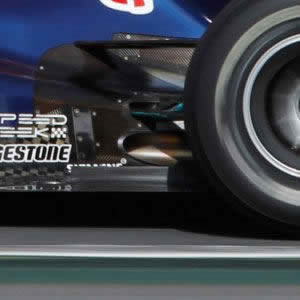
What really carried a massive advantage in recent years was exhaust blowing. Back in 2010, Redbull experimented with blowing hot exhaust gasses around the rear diffuser, a device at the back of the car which generates huge downforce and grip. The hot gasses coming out of the exhaust almost created an invisible barrier to keep air flowing through the diffuser affectively. The hot gasses also created pressure change which sucked more air through the diffuser. The result was a big increase in grip when the driver hit the throttle pedal coming out of corners. Redbull designer Adrian Newey knew he was onto a winner and and the aerodynamics of the Redbull were built around this concept to get maximum advantage, which led to the team's dominance.

Note the location of the exhaust exit
However when the driver came of the throttle pedal to brake, where downforce is important, the advantage dissapeared as there was no hot exhaust gas available. To stop this engine manufacturers programmed their engines to make the engine burn fuel even when the driver was off the throttle. The advantage became so big that cars where now overfilling their tanks with heavy fuel loads.

By 2011 every team was at it, and the designs becoming more advanced and hugely affective. I remember attending Silverstone that year, just as the FIA announced a ban on this technology only to get slapped back into place by teams complaining over lost performance. What I didn't really hear on television became much more apparent on track. The engines sounded like a low thudding machine gun when the cars braked for the corner and an acrid smell entered my nostrils. The video below gives you a good idea of the sound you for some reason never heard well through your television:


For the following season, the FIA stipulated the exhaust exit on the car had to be placed high up upon the sidepods rather than next to the diffuser. However teams as ever employed methods to get around this. With a small indent on the exhaust exit to direct exhaust gas down, using the 'co-anda' affect exhaust blowing was still, if a much more diminshed, important generator of downforce on the cars.

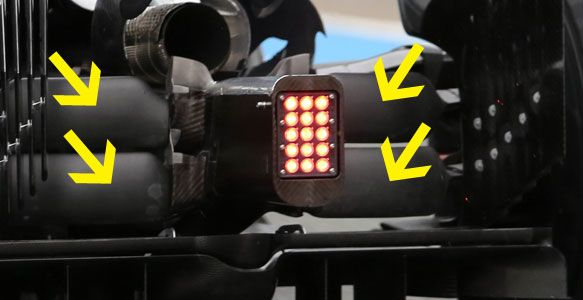
However for 2014 we now see the exhaust located in a central position ahead of the diffuser, making it impossible to direct exhaust gas towards the diffuser. "There will be a lot less downforce as there will be no [exhaust] blowing" stated Jenson Button before testing.  "I don't care what they say, there is still a massive amount of blowing on an F1 (2013) car."
Exhaust exit location for 2014

This change will mean a big reduction in downforce, and with the torquey turbo engines making wheel spin easier you will be seeing a lot of cars going sideways when exiting slow corners. Great!

Wing Changes

In an effort to reduce more downforce from the new cars the FIA and have made changes to the front and rear wing rules

In an effort to reduce punctures, the front wing has been shortened from 1800mm to 1650mm. As the front wing generates a vast amount of downforce on the car this will have a big impact. This also makes it harder for the front wing to direct air around the outside of the tyre. Teams will try a claw a small advantage back with now being able to direct airflow in between the car and the tyres.

The virtual box that the rear wing has to sit in stipulated by the FIA is now 20mm smaller. There is also the removal of the beam wing. Smaller area means less downforce. However in an effort to claw more downforce back McLaren has an innotive solution of shaping the rear suspension into an aerodynamically detailed 'blocker'. This blocks airflow travelling around the coke bottle rear bodywork of the car heading towards the diffuser. A pressure difference speeds up airflow under the car creating more downforce. This may give McLaren quite a big advantage in 2014 and is hard to copy due to the need of other components to work in harmony.

The new Mclaren's innotive 'blockers'

All these changes combined equal significant downforce loss. But ask any experienced F1 geek and he will tell you these losses will be clawed back in a year or two with new innovative concepts...


Sunday, 9 February 2014

2014 F1 Engines Explained

Its here.

Tag Me!
                                                                       

2014 is upon us and with it some of the biggest changes to Formula One cars for a generation! With phallic shaped nose cones causing a stir there is also another controversial change to the formula. Its out with the V8 engines of last year and in with smaller and greener high tech turbo-charged V6 engines.

Turbo

A view of the turbo at the back of the new Mercedes power plant
                            
Some of you might be asking - what exactly is a turbo? Less complicated than you think, a turbo is simply a device which uses pressure from what would be wasted exhaust gases exiting the engine to spin a turbine, which connected to a fan via shaft sucks more air to the engine generating more power. As you are making more power from what is waste, a turbo engine is a more efficient engine than a naturally aspirated (that means non turbo) engine. At the moment, with all the talk and worry of global warming car manufacturers are moving away from big engines to smaller, efficient turbos charged engines to reduce emissions. As modern Formula 1 has rich and powerful car manufacturers as investors, its no surprise they have steered the rules towards the new greener ethos of road cars.


You may now be thinking that turbos are perfect, right? There are a few downsides. The first is there are more moving parts in an engine generating huge pressure and heat. This means turbo engines can often break. To make them more reliable for every day use, road car manufacturers limit their turbos to produce a lot less power than they potentially can. In F1, where every fraction of a second counts, every team will be pushing their more complicated turbo engine to the limit. This means we will see what has become a rare site -more cars breaking down .

Secondly, from a drivers perspective turbo engines have less 'driveability'. The way the torque - the actual force of the engine - comes into play when a driver puts his foot down can feel delayed and, with big power, almost violently catch you unawares. You will have probably heard of 'turbo-lag' before. This was famously noticeable in 80's and 90's high performance turbo road cars, where you put your foot down hard and for a second or more and... nothing happened. Then all of a sudden the turbo spools into life and it feels like you are being propelled by a space rocket! This made those cars of old with quick 0-60 times ever more impressive, as a second or more was wasted with you not really going anywhere. This is because the turbo needs time for exhaust pressure to build to get it going. Modern road cars have fancy methods involving electronics and crafted turbos to make this delay pretty much unnoticeable, but it can not be completely hidden in powerful turbo engines. This why a lot of petrol heads and super car manufacturers like Ferrari and Lamborghini prefer the linear and normal power delivery of a normal naturally aspirated engine to a turbo. Non turbo engines are more predictable, its easier to judge your right foot as the power builds smoothly. 

Thirdly and finally turbos themselves are quite heavy and require the help of an intercooler to cool down all that compressed air coming into the engine. Although you have an efficient engine producing power from waste, there is still added bulky weight and cooling is much more important. These factors are hugely significant in F1 cars. Although the 2014 turbo engines are smaller and so is the fuel tank, the extra cooling requirements and bulky turbo (and other new engine bits for 2014 discussed later) will mean packaging the car behind the driver and keeping the weight down is a challenge for the teams. 

Ask an F1 geek about the turbo cars of the 80's and you will almost certainly get a positive reaction. The main reason behind this is ridiculous horsepower.
This was often over 10 times as powerful as your average family saloon car at around half the weight. Coupled with no traction control to help with wheel spin and little aerodynamic grip compared to today these legendary cars were a beast to tame and unreliable. Spiralling costs and scary speeds saw them banned in favour of naturally aspirated 3.5 litre engines.

This year the turbos are back, but in a very different format. The BMW M12 turbo engine in the back of the Brabham and Benneton cars of 1987 in qualifying trim, with tiddly 1.5 litre engines, produced approximately 1400 horse power.  This years 1.6 litre engines will be producing less than half of that - just over 600hp and around 760hp for 33 seconds of the lap with the new ERS system. 

So why are this years cars a lot less powerful if they are practically the same size? The main reasons are efficiency and reliability. In 1987 for example Brabham could run their monster BMW engine to 1400hp - but only for a few laps in qualifying. And even after a few laps it was not unusual for gearboxes and even the engines themselves to shatter into pieces.
Turbo engines of the 80's were notoriously unreliable
The immense pressures travelling through the engine could end in an explosion showering bits of piston, valves and connecting rods all over the race track.

Rather than just one race session, the new engines are designed to cover a lot more mileage. In fact, you can only change the engine a maximum of 5 times in the 19 race long season. Also, you can only change the turbo, electronics, energy store, and 2 parts of the ERS (described in the next section) 5 times a season or you will face the same penalty.

Rev Limit and Displacement

One of the most controversial changes to the engine is the reduction in RPM, or revs per minute and the reduction in displacement (pretty much the size of the engine). The distinct violent whining buzz of an F1 engine comes from is super ability to spin the crankshaft of its engine at insane speeds. Last years engines were limited to 18,000rpm but this year this limit is 15,000 rpm. Coupled with the reduction in size and the removal of 2 cylinders, the engines are noticeably quieter.

This is certainly a sour point for fans. My lasting memories of going to see Formula One races in the V10 and V8 era are of me approaching a the track from a distance hearing the violent thunderous aggression of an F1 engine getting louder and louder. Especially in the V10 era the sound would often vibrate advertisement boards and bridges. It was awesome.

Now we have news after Jerez testing of team managers being on mobile phones in the pit lane- something they were unable to do before because of the noise. It leaves me quiet worried but I am not going to make a full judgement until I hear them in person. The only added bonus is the sound of the turbo and the new energy recovery system whirring off throttle. Listen for yourself:


Energy Recovery System


Introduced in 2009 'KERs' took energy from braking and stored it as electrical energy that could be released when the driver required it for for just under 7 seconds a lap. Similarly for 2014, what is now 'MGU-K' (motor generator unit -kinetic) also takes energy created from braking through the power train, and stores this in the 'ES' (energy store) to be used as a boost when needed. However there is more wasted energy available to be harvested through the 'MGU-H' (motor generator - heat). This is an electrical generator connected to the turbine shaft of the turbo. When the car is braking and the turbo is not needed the turbine of the turbo will be freewheeling, but this would be wasted energy is harvested through the MGU-H and stored in the 'ES' (energy store) to be used when needed. This energy can be used as a boost, or instead used to spin the turbo up when power is required greatly reducing turbo lag. Also the MGU-H can be used to control the speed of the turbo turbines to reduce pressure if necessary acting in place of a waste gate.

In total the MGU-K can fire back a total boost of 4 mega joules per lap through the engine crankshaft giving around 160hp for 33 seconds. This is 10 times more energy than last years KERs which means failure of this system will be hugely detrimental to performance. Unlike last year were KERs was operated by a 'boost' button on the steering wheel, the 33 seconds of boost from the MGU-K will be pre-programmed into the car to boost automatically at set points over the lap. This can still be adjusted by the driver by changing to different engine maps on his steering wheel. Teams will have to calculate when that all important power boost will be needed.

Fuel

This years engines will produce similar power levels to last year during parts of the lap, yet will be over 30% more fuel efficient. This years formula is a fuel limited formula, in that engines are limited to 100kg of fuel per race. This year the emerging road car technology direct injection will make its F1 debut allowed in the new regulations. This allows fuel to be sprayed directly into the cylinders of the engine, rather than mixed with air through and intake valve. The result is more precise fueling and therefore increased efficiency.

Gearbox

Finally, another big change this year is the requirement for 8 speed gear boxes with set ratios for the whole season. On a track with long fast track such as Monza you want long gear ratios meaning higher top speed at the sacrifice of acceleration. But on a short slow track such as Monaco you want short ratios for quick acceleration out of slow corners at the sacrifice of top speed. While teams changed the ratios race to race now they do not have this luxury. A balanced ratio will be needed to give them and best performance for all the races in the season.


Tuesday, 9 July 2013

Mark Webber to leave F1 for Porsche's Le Mans challenge next year

       On the Thursday before the Silverstone weekend the teams kitted up the garages and we heard that the rumours were indeed true. Mark Webber had indeed signed a long term contract with Porsche to race an LMP1 car at Le Mans next year. Porsche’s return to the top class of Le Mans in LMP1 guise has certainly got sportscar enthusiasts geared up.  A topflight F1 driver is certainly a further boost to the sport. However, will this leave Mark’s legacy slightly tarnished, leaving F1 as a ‘nearly man’? Just like the recent retiree Giancarlo Fissichella, Webber was rated as a future champion, but when it was his time to shine that spark soon got stamped on by a dastardly and tremendously talented young team mate. Whatever your opinion there is no doubt Mark will leave F1 entirely dissatisfied.

Mark to bow out after 11 years in the business
 The important thing to remember is how old Mark is and what he has achieved during his long career. An awesome 5th place on his debut in a Minardi back in 2001 beckoned the dawn of a bright new talent, well liked and certainly quick.  Performances at Jaguar and Williams in following years impressed, but that maiden win eluded him in these teams in decline. Signing for the promising Red Bull team venture gave Webber the opportunity to spread his wings. After 2 seasons of the Adrian Newey’s car design coming into fruition, 2009 gave Webber a top car and for the next two years Webber shined as a serious championship contender and a worthy adversary to his new young teammate Sebastian Vettel. However, with Vettel developing into a phenomenal talent and a changing Red Bull team, it has not been all sweetness and light. Who can forget Turkey 2010 when Vettel swiped Webber off, with Red Bull quick to support the young German’s side of the garage. Even recently, senior Red Bull advisor and Vettel fan boy Helmut Marko openly criticised Webber as an inconsistent has been who can’t handle pressure. What is likely the catalyst for Webber’s exit from the team is Vettel’s disobedience of team orders to stay behind Webber at Malaysia this year. Anyone who has seen the on-board cam of this incident will notice a disgruntled Webber giving Vettel the finger as he was overtaken in violation of team orders and took the win.
Mark's car next year, the new Porsche LMP1


There is little doubt that a relationship like this can become corrosive quite easily. There has been tension bubbling between these two drivers for the many years together. Vettel openly stated that part of his antics at Malaysia was ‘payback’ for lack of support in the past.  At Silverstone 2011, a track Mark has always exceeded at, he also disobeyed team orders and tried unsuccessfully to throw it down the inside during the last 2 laps of the race. As Vettel has become interwoven within the fabric of the Red Bull team the car will be developed with his driving style conceded too more than Mark’s.  This environment surely is not healthy? Whatever the case I feel we have been robbed of a man still quick and in my mind more than capable of delivering a final blow to his dominant team mate in 2014. Signing out in a top car with talent shouldn’t be the way…

DMAN's F1 BLOG RETURNS!


Wednesday, 15 February 2012

"The only message I got was that there were some kids in trouble with the police" - Bernie remains defiant of Bahrain unrest


Mr Bernie Ecclestone has defied mounting political pressure and given the green light to race in troubled Bahrain. After last years cancellation due to safety fears, this year we will race on. Is it right? Put simply... NO!

Bahrain is riding the crest of the wonderful wave of uprisings against oppressive regimes in the middle east, the so called 'Arab Spring'. Although often complicated with sectarian divisions, heroically the people of the middle east are finally taking a stand against being trampled on by crackpot dictators and totalitarian regimes. In Bahrain, the Sunni minority are desperately clinging to power as the Shia majority population are rising up. The growing conflict has got even more violent in the recent month, leading to the government aggressively lashing out with bullets and Saudi military help. Even Shia employees at the Grand Prix circuit have been imprisoned.

Yet Bernie Ecclestone, completely out of touch with reality is behaving like a immoral business man by claiming that F1 is simply 'non political'. His comments of recent are laughable:

"The only message I got was that there were some kids in trouble with the police"


You honestly think what is bordering on potential civil war and making headline news around the world is simply a few pesky kids letting off some steam? Senile dementia is common in those above the age of 80.

"We've always been non-political....any decision will be made on grounds of safety." 


Say we were in pre war Nazi Germany with today's standard of moral consciousness. The German Grand Prix will go ahead, most likely to be won by a superior German car with a few million donated to the FIA by the Fuhrer himself. Bernie is used to the concept of bribes, he once donated £1 million to Tony Blair's Labour party and suddenly F1 was immune to UK tobacco advertising laws. Security at the race is tight, there is no chance of any trouble. Is F1 still non political? (if your interested, the 1938 German Grand Prix was won by British driver Richard Seaman in a Mercedes who gave Hitler the Nazi salute on the podium) .

Bernie's comments come in reaction to a recent letter from British government peers advising the race not go ahead. Then yesterday  Conservative MP Conor Burns and Labour MP Thomas Doherty of the suspiciously titled 'UK-Bahrain All-Party Parliamentary Group' stated the race should go ahead as “an incentive to the authorities in Bahrain [to show that it is serious about reform].  

So is this the truth or is there some other driving force behind Bernie's decision? Unsurprisingly, the answer is money. Big money.


On the run up to the then cancelled 2011 Bahrain Grand Prix, Mark Webber was the only driver with the balls to speak out, stating:

"When you hear of people losing their lives, this is a tragedy. It's probably not the best time to go there for a sporting event. They have bigger things, bigger priorities."

Then the ugly truth caught up with on Mark in the shape of the Redbull's Bahraini investers BMMI. At the next Grand Prix he uncomfortably refused to make any further comments on the situation or even back what he said previous. This sickens me to my stomach, and to make matters worse Redbull are not the only team with Bahraini sponsors, McLaren are another top team who's moral compass is swayed by the flow of cash. The government owned Bahrain Mumtalakat Holding company owns 30% of the team.
Have we been here before? In 1985 the F1 circus raced on in South Africa at the great Kylami race circuit. But this was under the disgraceful apartheid regime where blacks were segregated from whites. Many teams boycotted but often under pressure from their own national governments, like the French Ligier team. And many of the drivers were vocal of there distaste for apartheid. However they also explained that they were under contract to race at every event their team took them. One of those who stood out was Ayrton Senna, and in only his second year of F1 he decided to boycott the event. Unfortunately it dawned on him that a young up and coming driver racing for the renowned Lotus name would potentially damage his career prospects from being in breach of contract. The young Ayrton gave into the pressure, eventually retiring from the race with engine problems.


Of course apartheid South Africa is very different from the situation in Bahrain. While the Bahraini government is not afraid to use violence and torture, the country is regarding as one of the most democratic Arab nations. In fact last year's trouble bought about a government investigation into whether the security forces acted unlawfully, and surprising to many they judged themselves guilty of human rights abuses. But was this simply smoke and mirrors, an empty concession to the alter of the Western world to give the illusion of a democratic process?

The situation is also not as simple as the masses uprising against an evil few. It is a sectarian affair between different denominations of Islam, the Shia's and the Sunnis. However the Sunnis who rule the country are the minority population. The Bahraini security forces struggled with the unrest last year leading them to bring in the cavalry in the form of the Saudi army. Yes, Saudi Arabia, a government which amputate hands and limbs for petty theft and military are welcome customers of British Aerospace.


To me it seems an ubsurd situation and as a lifelong militant F1 fan who watches all racing live I am seriously considering not watching the 2012 Bahrain Grand Prix. For Bernie to simply plead his show is non political and burry his head under the sand is a stain on F1's reputation. Shame on you...


Monday, 13 February 2012

Car of the month - Ferrari F2002

Every month we will be featuring a brief breakdown of the cars that changed F1 and why. So lets start with the fastest car there ever was...ENJOY!


A piece of engineering genious in the hands of Michael Schumacher is devastating.

So devastating in fact the F2002 caused the FIA to 'ammend' their points system...

The F2002 is a complete work of art from the Ferrari stable. Designed by Rory Byrne, Ross Brawn and Paulo Martinelli, the car was a continued evolution of the highly successful and proven F2001 concept. This was a recipe for dominance and there is little wonder why the car completely dominated the 2002 season. Ferrari had so much confidence that the car was also used for the first 4 races of 2003.

The old F2001 was a car well built around the new regulations governing front wing placement and legalisation of electronic driving aids. It featured a drooped nose which worked well with its new front wing and revised rear suspension. The suspension geometry was tailored around the use of traction control. For the new F2002, Ferrari developed a brand new titanium gearbox which lowered the centre of gravity and decreased the gearbox weight by 15%. The gearbox also introduced clutchless direct shift technology. Amongst other things, they had successfully removed the bell housing in the gearbox. This cut down parts and made the gearbox stiffer, and therefore able to be built to a shorter length. Now Ferrari could sculpture their rear coke bottle shape to the extreme, meaning a very low drag rear end. The rear sidepods were very low, allowing more air to the rear wing.


In 1998, the car of the time the F300 debuted a new concept of mounting the exit of the exhausts on the engine cover, rather than exiting on the underside of the car by the diffuser. The advantage of this was that the hot exhaust gasses didn’t interfere with the diffuser and thus increased aerodynamic efficiency. Every team quickly copied this design. However, in 2000 during the Monaco grand prix it became apparent that this layout had potential reliability issues. Michael Schumacher fell victim to retirement after a broken exhaust became so hot that it melted through the rear suspension. Ferrari considered other areas where the exhausts could exit and came up with the idea of exiting the exhausts towards the outside of the car, on the sidepods with ‘chimneys’. This concept meant the shortened exhaust was now clear of the rear suspension. To aid aerodynamics, the exhaust gasses could also be channelled to avoid disturbing air flow to the rear wing. On top of this, the ‘chimneys’ allowed a low pressure area around the exhaust exit. This meant the exhausts actually ‘sucked’ the products of combustion out of the engine. This meant increased engine performance, an area which was already benefiting from increased revs due to the shorter exhausts.

 The car featured a higher nose than the F2001 with straighter proportions, thanks to a more compact front suspension. The front wing remained similar to the F2001, though it was a two part wing rather than three. Continuing the aerodynamic masterpiece, the cockpit was modified to sit the driver deep inside the cockpit. The cockpit surrounds where thinner and tuned in the wind tunnel to work better in conjunction with the driver’s helmet. The deeper seat also allowed a cleaner flow of air to the air box, marginally increasing horsepower. A new fluid traction control system was developed to further take advantage of the new legalisation governing driving aids. This increased the car’s acceleration out of slow corners and off the start line, as well as increasing all round driveability.
What you have is the ingredients for the ultimate F1 car. An evolution not a revolution based upon a championship winning chassis. Intricacies and details all added up to put together a highly potent package. And the F2002 demonstrated all these principles on the track. At first there were concerns with the reliability of the new gearbox during problems in testing. Ferrari wanted to continue their reputation of entering bullet-proof cars so delayed the use of their new weapon until the 3rd race of the season at Brazil. There it won in the hands of Schumacher and went on to win 16 out of 20 races. The car accumulated 221 constructor’s points in 2002 – more than every other team’s put together!

                          
                                                                                                                                            Dman